Mathematics: IGCSE, IB & A Level

We teach Maths at all academic levels up to Oxbridge entrance, with pupils carefully set according to their mathematic ability.

M

We believe that an appreciation of Mathematics is intrinsically important in its own right as well as in terms of its application. It also has a central role to play in relation to all other subjects.

Our eleven full-time teachers teach Maths at all academic levels up to Oxbridge entrance.

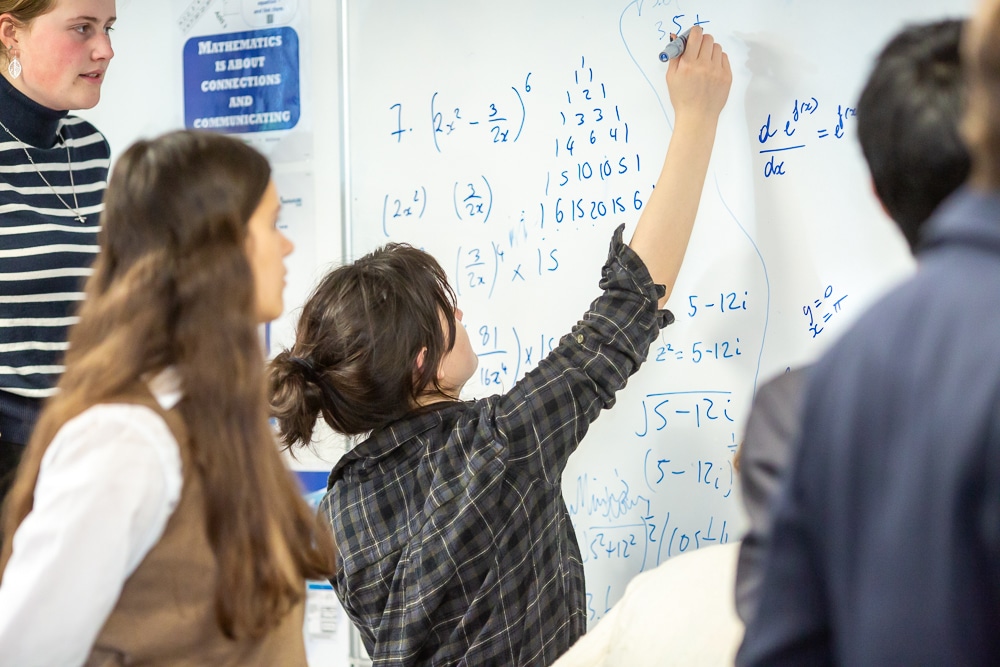
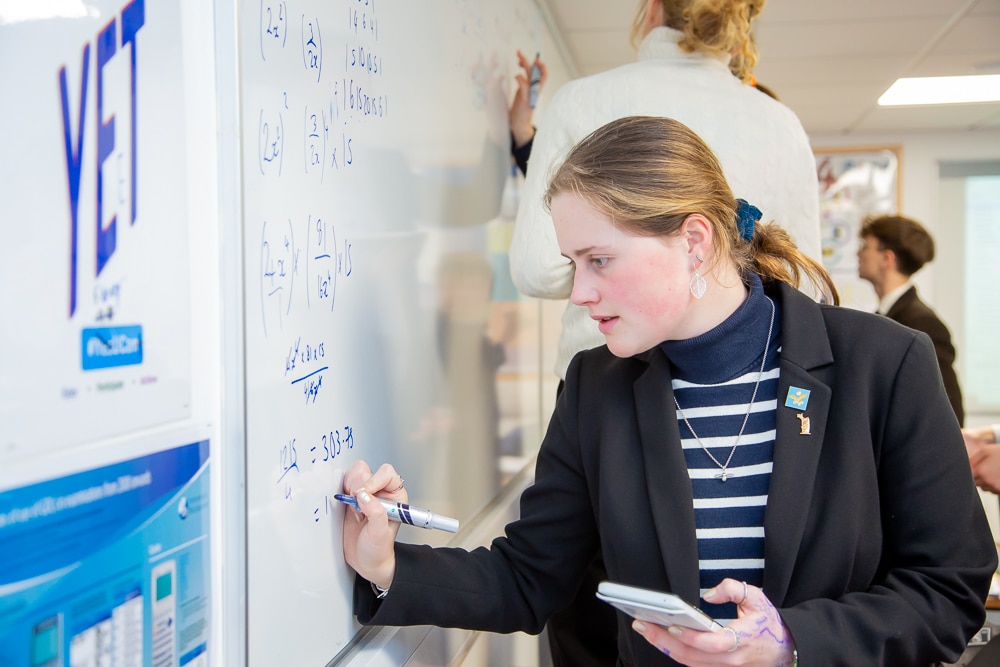
A girl working out an equation on a whiteboard

Course Specifications

GCSE: Mathematics

Although the IGCSE course is a 2-year course, all maths content in first year and beyond is teaching the skills necessary for those final exams. The foundation year covers modules in Algebra, Number, Shape and Space and Data handling, with the aim that the Foundation Tier work is fully covered by the end of the year.

In Year 10, the top set is accelerated to allow time to cover the Further Maths course in Year 11. The top few are given one lesson a week of problem solving, Olympiad extension questions, and the lowest set revisit the foundational work aiming to take the Foundation exam in their GCSE year. The top students in all three-year groups enter the Intermediate Maths Challenge.

In the Year 11, the top class compete in the Senior Maths Challenge along with Sixth Form pupils, and depending on the year group approximately 40 students will sit the AQA Further Maths exam. With many of our pupils undertaking the IB in Sixth Form, GCSE is not seen as the end of a maths journey, but a stepping stone. Therefore, pupils will be exposed to relevant content beyond the syllabus and many purchase a graphics calculator (Casio CG100) to prepare for the next step.

Specification details

Maths IGCSE – EdExcel IGCSE Mathematics A (9-1)

Further Maths IGCSE – AQA L2 Certificate in Further Mathematics (8365)

International Baccalaureate: Mathematics

Standard/Higher Level

Aims

Pupils at Malvern College will study either:

  • Maths: Analysis and Approaches
  • Maths: Applications and Interpretations

Analysis and Approaches is focused on algebraic methods, trigonometry and calculus. It is very much a continuation of a current maths course, but with a non-calculator element.

  • At Higher Level pupils need to very confident with algebraic processes. This could be evidenced by a 9 at (I)GCSE or a good grade in a Further Maths GCSE.
  • At Standard Level pupils need to be confident with algebraic processes and the ability to work without a calculator. This could be evidenced by a 7/8 at (I)GCSE. Pupils with lower grades will find the course challenging.

Applications and Interpretations is focused on mathematics in real-life problems and contexts. There is a greater emphasis on statistical methods and probability, and solving problems using technology.

  • At Higher Level, pupils need to be confident mathematicians and quick learners, evidenced by 8/9 at (I)GCSE
  • At Standard Level, the course is designed to be accessible to all.

Course Content

The table below gives a comparison of the subjects studied.

Analysis & Approaches Applications & Interpretation
Standard Level Higher Level Standard Level Higher Level
Number & Algebra Arithmetic & Geometric sequences, Logarithms & Exponentials, Proof & Binomial Theorem. Permutations & Combinations, Partial Fractions, Complex numbers, proof by induction, solution of systems of equations. Arithmetic & Geometric sequences – loan repayments. Simple logs and exponents. Laws of logarithms, Complex numbers and practical applications, matrices and applications.
Functions Straight lines, properties of functions & graphs, composite, inverse, identities, transformations. Factor & Remainder Theorem, roots of polynomials, odd and even functions, inequalities and modulus functions. Modelling with range of graphs. Log-Log graphs, further transformations and piecewise functions.
Geometry & Trigonometry 3D solids, non-right-angled trigonometry. Radian measure, unit circle, solving trigonometric equations. Inverse and reciprocal trig functions, vector theory, applications with lines and planes, and vector algebra. Vol and SA of 3D shapes, trigonometry, positions & paths using Voronoi Diagrams. Vector concepts, applications in kinematics, adjacency matrices, tree and cycle algorithms.
Statistics & Probability Measures of central tendency & spread, correlation, regression, probability, normal and binomial distributions. Bayes Theorem, probability distributions and expectation algebra. Measures of central tendency & spread, correlation using Pearson’s and Spearman, regression, Chi squared test. Binomial & Poisson Distributions, hypothesis testing & confidence intervals.
Calculus Differentiation to find tangents & normal, optimisation, kinematics, chain, product & quotient rule. Definite and indefinite integration. First principles, limits & L’Hopital’s rule, Continuity & Differentiability, implicit differentiation, integration by parts & substitution, differential equations, Maclaurin Series. Differentiation, including graphical behaviour of functions, and optimisation. Trapezium rule. Kinematics & rates of change, Differential equations, slope fields, 2nd order diff equations in context.

In both cases the Standard Level content is a subset of the Higher Level content

Assessment Details

Analysis and Approaches

Paper Time Weighting Content
1 2 hrs Higher Level

1.h hrs Standard Level

30% Higher Level

40% Standard Level

Non Calculator Long and Short answers
2 2 hrs Higher Level

1.h hrs Standard Level

30% Higher Level

40% Standard Level

Calculator Long and Short answers
3 1.25 hrs Higher Level only 20% Calculator 2 extended problems
Internal assessment Approx. 30 hours 20%

The Syllabus

Specification

Applications and Interpretations

Paper Time Weighting Content
1 2 hrs Higher Level

1.h hrs Standard Level

30% Higher Level

40% Standard Level

Calculator Short answers
2 2 hrs HL

1h Standard Level

30% Higher Level

40% Standard Level

Calculator Long answers
3 1.25 hrs Higher Level  only 20% Calculator 2 extended problems
Internal assessment Approx. 30 hours 20%

The Syllabus

Specification

Further Information

A Graphics calculator is essential for both of these courses. We recommend the Casio CG100 as this will be modelled in lessons.

A level Mathematics

Aims

It is intended that the A level Mathematics course should encourage pupils to:

  • Develop their understanding of Mathematics and mathematical processes in a way that promotes confidence and fosters enjoyment;
  • Develop abilities to reason logically, to generalise and to construct mathematical proofs;
  • Extend their range of mathematical skills and techniques and use them in more difficult, unstructured problems;
  • Develop an understanding of coherence and progression in Mathematics and of how different areas of Mathematics can be connected;
  • Recognise how a situation may be represented mathematically and understand the relationship between ‘real world’ problems and possible mathematical models;
  • Use Mathematics as an effective means of communication;
  • Read and comprehend mathematical arguments and articles concerning applications of Mathematics;
  • Use technology such as calculators and computers when appropriate, recognise when such use may be inappropriate and be aware of limitations;
  • Develop an awareness of the relevance of Mathematics to other fields of study, to the world of work and to society in general;
  • Take increasing responsibility for their own learning and the evaluation of their own mathematical development.

Course Content

An A level Mathematics pupil is expected to engage with prior learning during the summer holiday prior to Sixth Form starting. This content covers approximately half of the Maths AS Pure maths course, which is bedding in ideas from IGCSE and developing them into slightly more challenging contexts. Students are assigned tasks on the Dr Frost maths platform to complete.

The Course is taught by 2 teachers delivering 3 lessons per week, each and is broken down as follows:

Teacher 1 Teacher 2
Year 1 Pure Maths: Calculus Pure Maths: Trigonometry Pure Maths: Functions, numerical methods, algebraic techniques Statistics: Probability, Regression, Hypothesis Testing, 1 variable and 2 variable statistics. distributions
Year 2 Pure Maths: Calculus (Integration methods) Mechanics: modelling, constant and variable acceleration, moments, forces, projectiles Pure Maths: Numerical methods, sequences and series, functions Pure Maths: Revision of Pure Maths content.


Testing is done at half term and end of terms, tracking pupils according to their target grades.

The Syllabus

Examination board: Edexcel A Level Mathematics

Over two years, the course is divided up by time approximately shown below.

Pure Maths Application
Topics Time Topics Time
1 – Proof 3 1 – Statistical sampling 3
2 – Algebra and functions 60 2 – Data presentation and interpretation 13
3 – Coordinate geometry in the (x, y) plane 10 3 – Probability 10
4 – Sequences and series 6 4 – Statistical distributions 18
5 – Trigonometry 30 5 – Statistical hypothesis testing 6
6 – Exponentials and logarithms 12
7 – Differentiation 25 6 – Quantities and units in mechanics 3
8 – Integration 35 7 – Kinematics 20
9 – Numerical methods 7 8 – Forces and Newton’s laws 22
10 – Vectors 12 9 – Moments 5


Assessment Details

The course is examined by three 2-hour-long papers, each worth 100 marks.

Paper 1: Pure Maths

Paper 2: Pure Maths

Paper 3: Application (Statistics and Mechanics sections)

Further Information

A grade 8 or 9 is recommended at IGCSE to stand a reasonable chance of obtaining a high grade in A level. If attempting with a grade 7, there is a likely chance that a low grade will be gained.

Pupils are advised to have a graphics calculator to make the most of this course. Lessons will be delivered with the Casio CG100 as the demonstration calculator.

A level Further Mathematics

Aims

The aim is to challenge the most able mathematicians and provide stretch for those who have achieved the highest grade in AQA Further Maths (or equivalent), and would find Maths A Level on its own too straightforward.

It is a course that explores areas of maths beyond the normal syllabus and is therefore an excellent foundation for anyone contemplating a mathematics degree at university.

Course Content

There are two courses provided, at AS level and at A level with both having an obligatory component and a choice of two modules from eight to complete the course.

Compulsory Options
Core (Year 1) Further Mechanics 1 Further Statistics 1 Further Pure 1 Decision Maths 1
Core (Year 2) Further Mechanics 2 Further Statistics 2 Further Pure 2 Decision Maths 2

The table below shows how the teaching might work for the 2 years and both courses.

Lower Sixth Upper Sixth
Course 6 lessons Enrichment lessons 6 lessons Enrichment lessons
AS Further With AL Maths class Further Core 1 With AL Maths Class F. Statistics 1 F. Mechanics 1
A Further All of AL Pure and Statistics Mechanics

Further Mechanics 1

Further Core 2 Further Pure 1

It is possible for pupils to start the Further Mathematics A Level course and in Year 2 drop to Further Mathematics AS course. They then have the advantage of doing the more challenging work from the A level course again.

The Syllabus

Further Maths A Level

Further Maths AS Level

Assessment Details

Further Maths AS level is assessed by 1 compulsory core paper (1 hr 40 mins) and 2 option papers (which are approximately half of the Further Mathematics module) both of which are 50 mins long.

Further Maths A Level is assessed by 4 paper (2 compulsory Core maths and 2 option papers) of 1 hr 30 mins each.

Further Information

For those attempting Further Mathematics AS course, we would recommend a 9 in IGCSE (or equivalent) and a decent pass in a further maths qualification (OCR Additional Maths / AQA L2 Further Maths / Edexcel Further Maths)

For those attempting the full Further Maths course, we would insist on a 9 at IGCSE and an 8 or 9 at a further maths qualification.